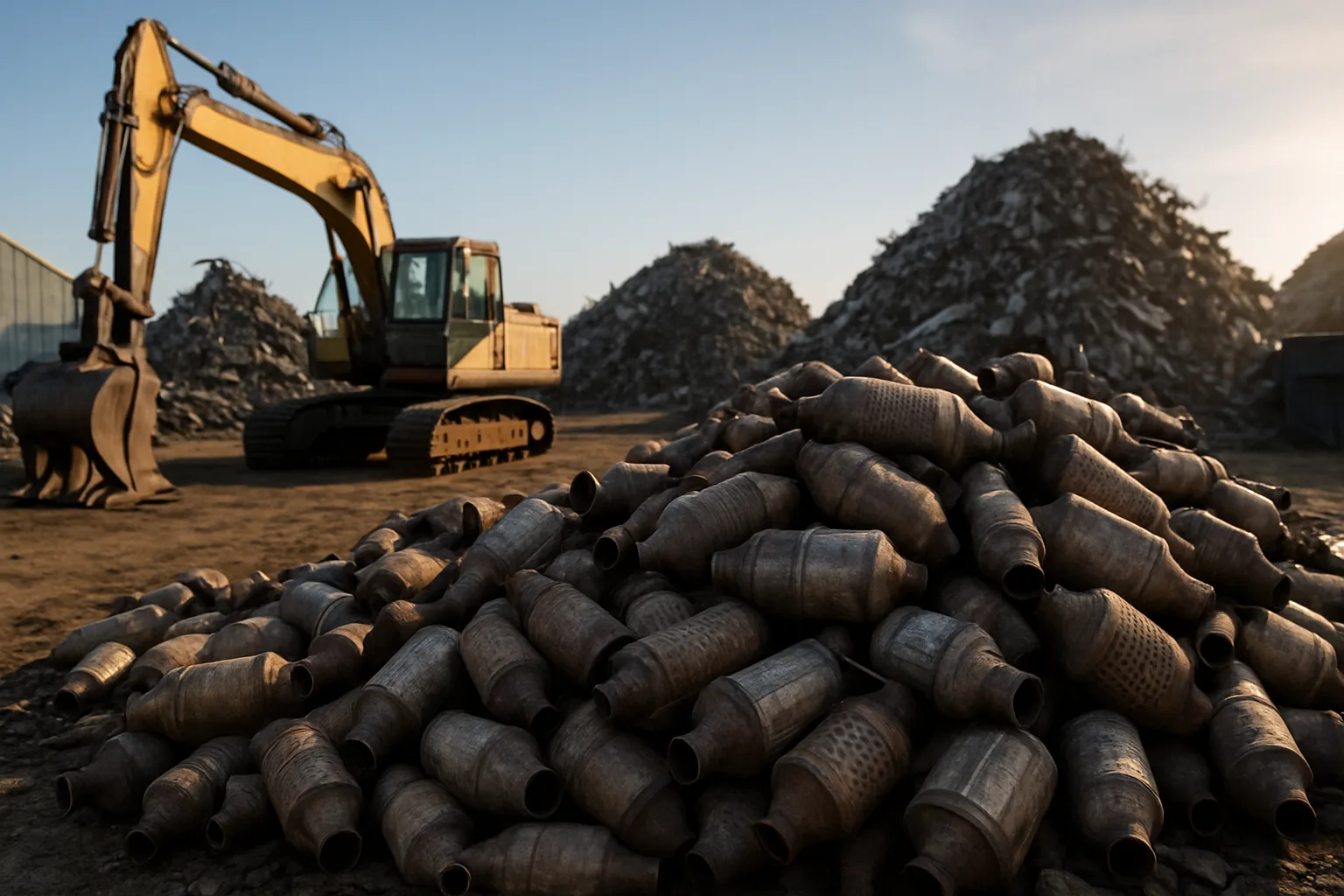
Why Does Your Catalytic Converter Quote Change Every Week?
You pull a cat off a vehicle, call your usual buyer, and get a number that feels low. You call someone else. Different number. Call a third buyer — now you're really confused. This isn't a glitch. It's how catalytic converter recycling actually works, and understanding it puts more money in your pocket.
Catalytic converter prices are among the most volatile in scrap metal. Unlike steel or aluminum — where scrap metal prices today follow fairly predictable commodity trends — cats swing hard based on a set of variables most sellers never see. This piece breaks down exactly how that pricing works, why it varies so dramatically, and how Milwaukee-area recyclers are using competitive auctions to stop leaving money on the table.
What's Actually Inside a Catalytic Converter — and Why It Commands High Prices
Strip away the steel shell and you'll find a ceramic or metallic substrate coated with platinum group metals (PGMs): platinum, palladium, and rhodium. These three elements do the heavy lifting in emissions reduction, and they're extraordinarily valuable. Rhodium alone has traded at multiples of gold's price in recent years. The catch? The quantities are measured in troy ounces per unit — sometimes fractions of an ounce — so getting accurate assay data matters enormously.
The steel shell itself carries some aluminium scrap value, but that's not what drives the price. It's the PGM content that determines whether a cat is worth $50 or $500+. And that content varies based on:
- Vehicle make, model, and year — different engines require different catalyst loads
- Original equipment manufacturer (OEM) — domestic vs. foreign makes have different PGM formulations
- Converter type — pre-cats, standard cats, diesel particulate filters (DPFs), and aftermarket units all price differently
- Condition — rattled-out, cracked, or damaged substrates mean less recoverable PGM
- Whether it's been previously processed — a "gutted" cat shell is worth almost nothing
This is why serial number tracking matters. Serious buyers use serial or part numbers to identify exactly what they're pricing. Platforms like SMASH build this into the selling process — serial tracking and photo documentation give buyers the confidence to bid aggressively instead of discounting for uncertainty.
How Catalytic Converter Recycling Actually Works — From Your Yard to the Smelter
Most sellers see one step: hand over the cat, get paid. But there's a full chain behind that transaction, and every link in it affects your payout.
Here's the typical flow:
- Collection — Cats are pulled from vehicles at dismantlers, body shops, or directly at the recycling yard.
- Identification and grading — Units are sorted by type and condition. This is where serial lookups and databases come in. Accurate identification at this stage is critical to getting a fair price.
- Aggregation and sale — Yards typically batch cats and sell them to a processor or middleman buyer.
- Decanning — The steel shell is removed, and the substrate is crushed into powder (called "spent catalyst" or "black powder").
- Smelting and assay — The powder is smelted and sampled. The actual PGM content is measured. This is the "ground truth" of the cat's value.
- Settlement — The refiner pays based on assay results, minus processing fees. That settlement price works backward through the chain to determine what your buyer originally offered you.
The problem for most sellers? They're transacting at step 3 without visibility into steps 4 through 6. A single buyer quote gives you one data point from one buyer with one set of margin expectations. That's a guessing game, not a market price.
Why Catalytic Converter Prices Vary So Much — Even on the Same Day
On any given day, the same cat might get quoted at materially different prices by different buyers. Here's why:
PGM spot prices move daily. Platinum, palladium, and rhodium all trade on global commodity markets. A buyer who locked in a forward contract last month might quote differently than one who's pricing off today's spot. Check current scrap metal prices regularly — what was accurate last Tuesday may already be outdated.
Buyer margins vary widely. Some buyers operate lean and pass on most of the value. Others build in significant spreads. With one buyer, you have no way to know where you fall on that spectrum.
Identification errors compound the problem. If a buyer misidentifies your cat — or deliberately grades it down — you lose money before negotiation even starts. Photo documentation and serial tracking close this gap.
Volume and relationship pricing. A buyer who wants your ongoing business might quote sharper than someone buying opportunistically. But "relationship pricing" that never gets challenged by competition isn't necessarily competitive pricing.
For scrap metal recyclers in Milwaukee and across Wisconsin, this variance is especially meaningful when moving volume. If you're selling dozens of cats per week, even a small per-unit difference adds up fast.
The Case for Competitive Auctions — What Changes When Multiple Buyers Compete
This is where the SMASH model changes the math. Instead of one quote from one buyer, you get multiple vetted buyers competing for your load. That competition does something a single quote never can: it reveals what the market will actually pay.
A Milwaukee recycler running a mid-sized operation recently described the shift this way: they'd been selling cats to the same buyer for years, assuming the relationship meant they were getting a fair deal. When they listed their first load on the SMASH scrap metal marketplace, they saw bids from buyers they'd never contacted — buyers with different cost structures, different smelter relationships, and different appetite for the specific types they were moving. The result wasn't a lottery. It was genuine price discovery.
That's the core value of a catalytic converter auction format. It doesn't guarantee the highest possible price on every load. What it does is replace guesswork with competition, and single-source pricing with a real market. More buyers bidding means better information for the seller.
SMASH also handles the documentation side — photo uploads, serial tracking, and auto-invoicing — so buyers bid with confidence and sellers don't spend hours chasing paperwork. For busy yards, that operational lift matters as much as the price difference.
How Milwaukee Recyclers Can Get More for Their Cats Right Now
If you're operating in the Milwaukee area and selling catalytic converters the old way — phone call, one quote, done — here's a practical framework for improving your returns:
Step 1: Document everything before you sell. Photograph each unit. Record the serial number or part number if visible. Note the condition. This takes minutes and protects you from low-ball grades from buyers who claim uncertainty.
Step 2: Know what you have. Use a serial number database or buyer-side lookup tool to identify the converter type. Knowing whether you have a foil-type foreign cat, a domestic pre-cat, or a DPF changes your leverage in any negotiation.
Step 3: Get multiple data points. Even if you prefer your current buyer, run a load through a competitive process periodically. You'll quickly learn whether your standing relationship is actually competitive or just comfortable. Find the best scrap metal prices today by comparing what the market actually offers — not just what one buyer tells you.
Step 4: Use a platform that handles the back-end. Milwaukee scrap metal services through best-scrap-prices.com connect local sellers with competitive buyers and current market data — so you're not starting from zero every time you want to check your numbers.
Step 5: Watch PGM spot trends. You don't need to be a commodity trader. But knowing whether platinum and palladium are trending up or down helps you decide whether to hold a load or move it. Check the latest scrap metal pricing guides for market context that actually applies to what you're selling.
Scrap metal prices today reflect real-time global market conditions. Selling without that context means you're always reacting instead of positioning.
Catalytic converter recycling rewards sellers who understand what they have and who compete for their price. The yard down the street using an auction format isn't doing something complicated — they're just not accepting the first number they hear. If you want to get serious about what your cats are worth, start with documentation, add competition, and stop treating your buyer's quote as the final word.
Ready to stop guessing? Check rates at best-scrap-prices.com and see what competitive pricing actually looks like for catalytic converters in your market.
Frequently Asked Questions
Q: What determines the price of a catalytic converter when I sell it for scrap?
The price is driven primarily by the platinum group metal (PGM) content — platinum, palladium, and rhodium — embedded in the substrate. Vehicle make, model, converter type, and condition all affect how much PGM is recoverable. Accurate identification through serial numbers significantly improves the accuracy of any quote you receive.
Q: How much do catalytic converter prices vary day to day?
They can vary significantly. PGM spot prices — especially rhodium and palladium — are volatile commodity markets that move daily. A converter quoted on Monday may fetch a different number by Friday. Checking scrap metal prices today before you sell gives you a current baseline rather than relying on outdated quotes.
Q: Where can I sell scrap metal near me in Milwaukee for the best price?
Start by comparing multiple buyers rather than defaulting to one. Local Milwaukee recyclers are increasingly using competitive auction platforms like SMASH to get real market pricing instead of a single take-it-or-leave-it quote. Best-scrap-prices.com helps you find current rates and connect with buyers active in your area.
Q: Are aftermarket catalytic converters worth less than OEM units?
Generally, yes. Aftermarket converters typically contain lower PGM loadings than original equipment units, which reduces their scrap value. Some aftermarket units are worth a fraction of a comparable OEM cat. This is one reason serial tracking and proper identification matter — so you and your buyer agree on exactly what you're selling.
Q: Does SMASH work for smaller loads of catalytic converters, or only large volumes?
SMASH is built for yards of varying sizes. Whether you're moving a handful of cats or a full pallet, the competitive auction format applies the same principle: multiple vetted buyers, documented inventory, and price discovery through competition — not guesswork. No subscription fees means you're not paying to participate before you know the outcome.
Stay sharp on what's moving in the scrap market. Follow SMASH on LinkedIn for industry updates, PGM market insights, and scrap pricing news that actually matters to your operation.
Disclaimer: Catalytic converter prices and PGM spot values fluctuate constantly based on global commodity markets. All price references in this article are general in nature. Always check current rates before selling.
```